Finding Meow Strategy Guide: 5 Meowdoku Techniques to Solve 7×7, 8×8 and 9×9 Grids Without Guessing
The first 25 levels of Finding Meow mostly solve themselves: place the obvious cat, let the game cross out its row, column and neighbours, and look for the next region with one cell left. Then Chapter 3 opens a 7×7 board with a twelve-cell region, after one free cat nothing else is down to one cell, and the three hearts in the corner suddenly feel very precious.
This guide is for that moment. It covers the five techniques that solve every big Finding Meow board, each shown on a real level from the game, and then walks through Level 26, the first Autumn Leaves level, from the opening position to the last cat. If you have not played yet, start with our beginner's guide to Finding Meow, which covers the rules, the controls and a solved 5×5 level.
The same ideas work for any puzzle in this family, so if you play Star Battle (one-star), the daily Queens puzzle or any other Meowdoku, everything below applies.
Why big boards feel hard, and why guessing is a bad deal
On a 5×5 board a single cat removes most of the grid. On a 9×9 board a cat removes at most 20 cells out of 81, and the regions are big enough that three or four of them stay wide open. There are fewer free cats, so you have to make progress with X marks before the next cat appears.
Guessing is tempting and expensive. A wrong cat costs a heart, you only have three, and a lost puzzle has to be restarted from the beginning. A hint, on the other hand, is free: it places a correct cat and costs nothing but a little pride. So the rule for big boards is simple: mark X marks with certainty, and when you are truly stuck, spend a hint rather than a heart.
Every board is generated with exactly one solution and checked before you see it, so a logical next move always exists. The techniques below are how you find it.
Technique 1: Free cats
Every Journey level (and almost every Classic board) has at least one single-cell region. A one-cell region must contain its cat, so it is a free move. Look for it first, place it, and let the automatic X marks do their work.
After that, the question to keep asking is: does any region, row or column have exactly one free cell left? If so, that is a cat. This is the move that finishes most boards, and the other four techniques exist to create it.
Technique 2: A region squeezed into one line
If every free cell of a region lies in a single row, that region's cat is in that row. Since the row can only hold one cat, every other cell in that row gets an X, whatever region it belongs to. The same goes for columns.
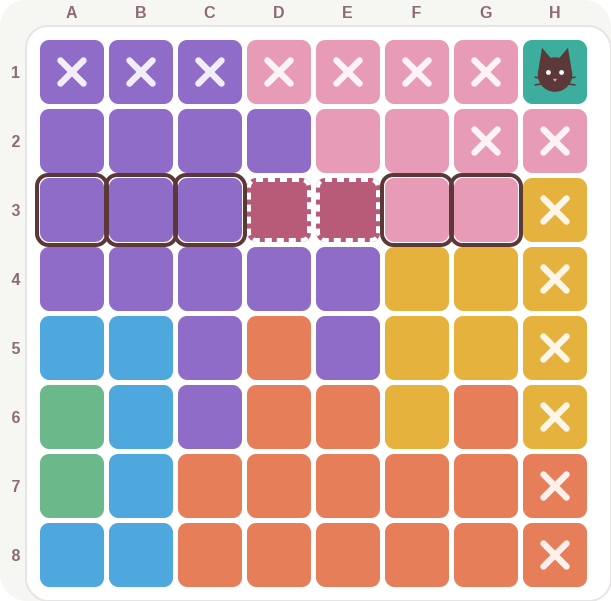
This is Level 40, an 8×8 Winter Frost board, at the very start. The rose region is just two cells, D3 and E3, both in row 3. Whichever one gets the cat, row 3 is spoken for, so A3, B3, C3, F3 and G3 can all be crossed out. One glance, five X marks. Once row 3 is crossed out, the pink region is down to E2 and F2 and does the same thing to row 2, and the green and blue regions squeeze columns A and B. Four regions, thirteen X marks, before you have placed a single cat yourself.
Small regions are the usual source of this move, but check big ones too: once a few X marks land in a large region, what is left of it is often one row or one column.
Technique 3: A line owned by one region
The mirror image. Look at a row. If all of its free cells belong to the same region, then that region's cat must be in this row, because the row needs a cat from somewhere. So every other cell of that region, outside the row, gets an X.
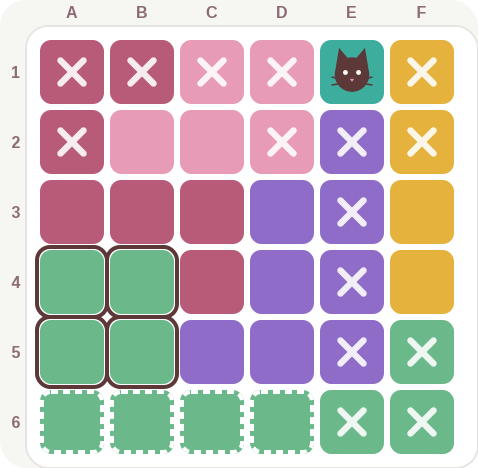
Here on Level 16 (6×6), once the gold region (down to F3 and F4 after the starting cat at E1) has crossed out the rest of column F, the free cells of row 6 are A6, B6, C6 and D6, all green. The green cat is therefore in row 6, and the green cells up in rows 4 and 5 (A4, B4, A5, B5) can be crossed out. That is what turns a big L-shaped region back into something manageable.
This one is easy to miss because you are looking at a line and thinking about a region. Make it part of your scan: for each row and each column, how many different colours are still free in it? One colour means a move.
Technique 4: Two regions, two lines
An extension of Technique 2. If two regions have all their free cells inside the same two rows, those two rows must hold those two cats. Nothing else can have a cat in either row, so every cell in those rows that belongs to a third region gets an X. The same holds for columns, and in principle for three regions in three lines, though pairs are what you will actually meet.
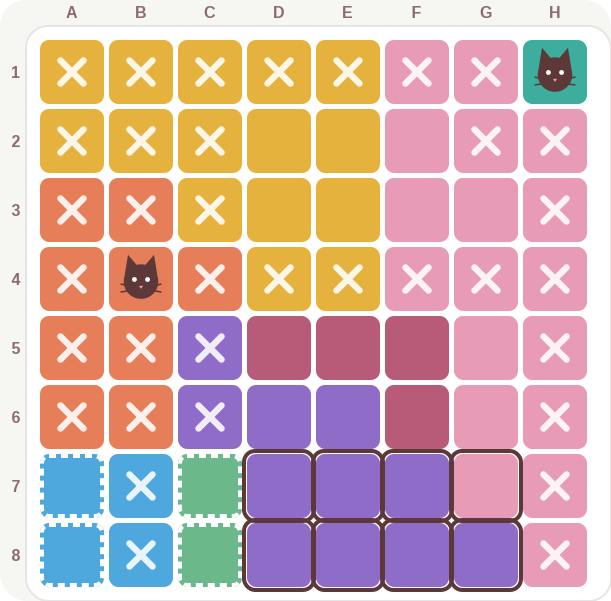
On Level 46 (8×8) the green region is down to C7 and C8, and the blue region to A7 and A8. Both live entirely in rows 7 and 8. Two regions need two cats, and two rows can hold exactly two, so the lavender and pink cells in those rows, D7 through G7 and D8 through G8, all get an X. Eight cells gone, and the big lavender region shrinks to two cells in row 6, which immediately squeezes row 6 in turn.
The pattern to look for: two small regions lying side by side along the same two rows or columns, often near an edge.
Technique 5: The cat that would block its neighbour
This is the technique that unsticks almost every hard position, and the one that beginners do not know. Pick a free cell and imagine a cat there. It would cross out its whole row, its whole column and its eight neighbours. If that would remove every free cell of some other region, the imagined cat is impossible, and the cell gets an X.
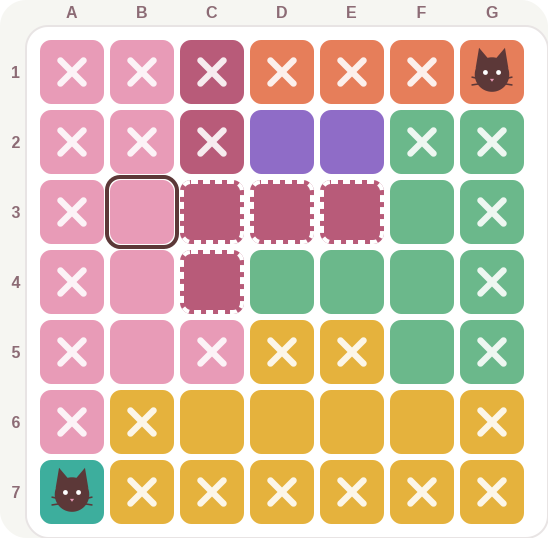
On Level 26 the rose region is down to C3, D3, E3 and C4. Now look at B3, a pink cell. A cat at B3 would cross out C3, D3 and E3 (same row) and C4 (diagonal neighbour). That is the entire rose region with nowhere left to go, so B3 cannot be a cat. X.
The same check works against rows and columns, not just regions: if a cat at some cell would wipe out every free cell of a different row or column, it is impossible. In practice the region version is the one you use, and the best cells to test are the ones next to a small region: a cell in the same row as a two-cell region, or diagonally touching both cells of it, is nearly always an X.
A scanning routine for big boards
When you sit down to a 7×7 or bigger board, run through the board in this order and go back to the top after every cat:
- Any region, row or column with one free cell? Place the cat (Technique 1).
- Any region whose free cells sit in one row or one column? Cross out the rest of that line (Technique 2).
- Any row or column whose free cells are all one colour? Cross out that region's other cells (Technique 3).
- Any two small regions sharing two lines? Cross out the third-party cells (Technique 4).
- For each small region, test the cells around it. Would a cat there block the whole region? X it (Technique 5).
Steps 1 to 3 are quick and get you most of the way. Steps 4 and 5 are slower, so only reach for them when the quick ones run dry. If you have been through all five and nothing moves, take a hint rather than guess; it is very rare, and when it happens the hint usually opens the board straight back up.
A real 7×7 level, solved step by step
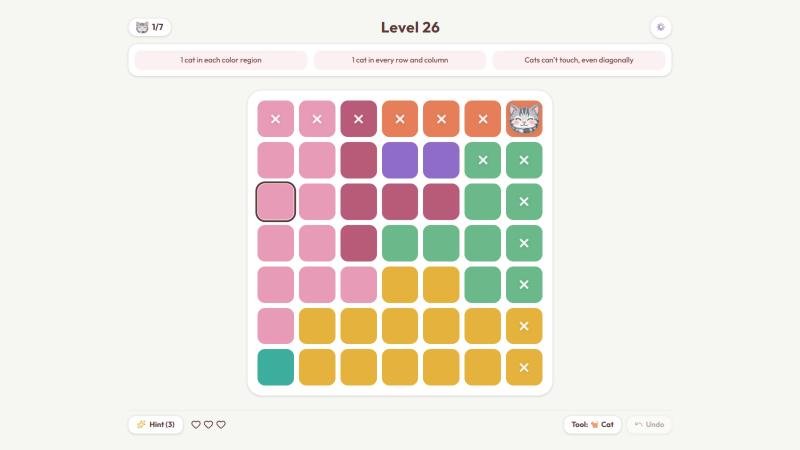
Here is Level 26, the first Autumn Leaves level and the board in the screenshot at the top of this guide. In the diagrams, columns are A to G from the left and rows 1 to 7 from the top. The game has given you one cat at G1, in the coral region along the top edge, and has crossed out row 1, column G and the neighbours of G1. (That is the cat you get when you open the game fresh or arrive from Level 25. Arrive from a different level and the game may reveal another cat of the same solution instead; the techniques are the same, but your first few steps will differ.)
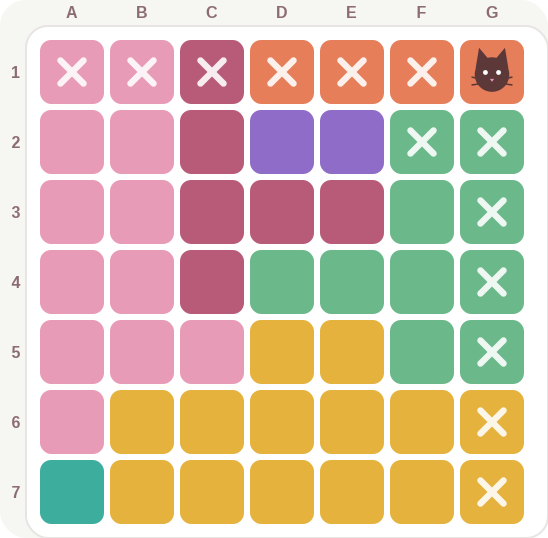
The regions: coral D1 to G1 (done, its cat is placed), pink the big block on the left (columns A and B, plus C5), rose C1 to C4 plus D3 and E3, lavender just D2 and E2, green the right side from row 2 to row 5, gold rows 6 and 7 plus D5 and E5, and teal, a single cell at A7.
Step 1, a free cat. Teal is a one-cell region, so the cat goes at A7. The game crosses out row 7, column A and B6.
Step 2, a squeezed region. Lavender is D2 and E2, both in row 2, so B2 and C2, the other free cells of row 2, get an X (Technique 2).
Step 3, an owned row. Row 6 now has free cells at C6, D6, E6 and F6, all gold. The gold cat is in row 6, so the gold cells up in row 5, D5 and E5, get an X (Technique 3).
Step 4, an owned column. Column B has free cells at B3, B4 and B5, all pink. The pink cat is in column B, so pink's one remaining cell outside it, C5, gets an X (Technique 3 again).
Step 5, a cat that would block. Rose is down to C3, D3, E3 and C4. A cat at B3 would see all four, so B3 is an X (Technique 5, the position in the picture above).
Steps 6 and 7, the same idea twice. D3 is directly below lavender's D2 and diagonal to E2; a cat there would leave lavender with nothing. D3 is an X. E3 is the mirror image: below E2, diagonal to D2. E3 is an X.
Step 8, rose is squeezed again. With D3 and E3 gone, rose is just C3 and C4, both in column C. The last free cell of column C outside rose, C6, gets an X.
Step 9, one more block. B4 is diagonal to C3 and next to C4. A cat there would finish rose off, so B4 is an X.
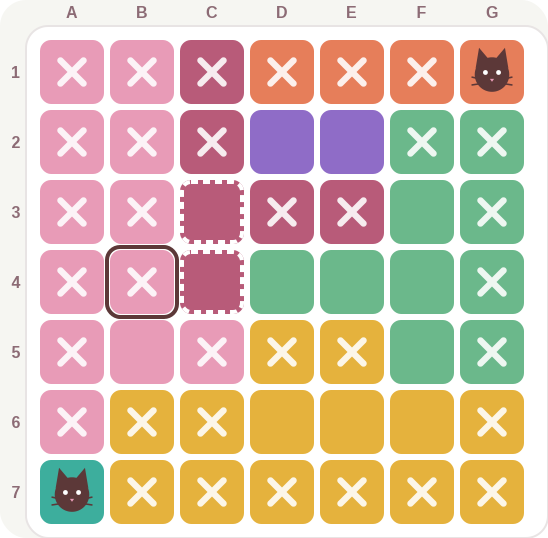
That is the picture after nine moves. Only two cats are on the board, but look at the regions: pink is down to B5, rose to C3 and C4, lavender to D2 and E2. From here it is a cascade.
Step 10. Pink has one free cell, so cat at B5. The game crosses out row 5 and C4 (a diagonal neighbour), among others.
Step 11. Rose is now just C3. Cat at C3. That removes D2 (diagonal) and D4, and the rest of row 3.
Step 12. Lavender is just E2. Cat at E2. That removes E4 and the rest of column E.
Step 13. Green has one cell left, F4. Cat at F4. That removes F6.
Step 14. Gold has one cell left, D6. Cat at D6. Seven cats, one per region, row and column, none touching.
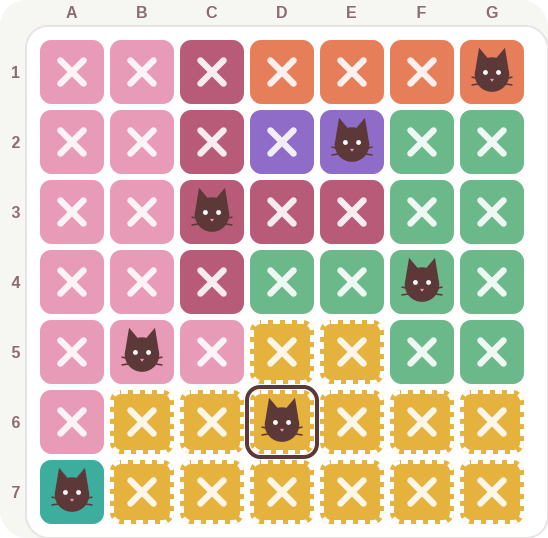
Count the techniques: one free cat to start, then eight X-mark deductions using Techniques 2, 3 and 5, then five cats in a row. That shape, a slow opening of X marks followed by a fast finish, is what nearly every big board looks like. If the cats are not coming, you are not behind; you are in the X-mark phase.
Winter Frost and Zen Master: the 8×8 and 9×9 boards
The techniques do not change on the biggest boards, but the habits matter more:
- Work from the small regions outward. On a 9×9 board there is still a one-cell region, and usually a two- or three-cell one. Everything near them is where the early X marks live. The twelve-cell regions take care of themselves once the small ones are solved.
- Treat each new cat as a reset. A cat on a 9×9 board removes up to 20 cells. Go back to step 1 of the scan every time, because the cheap moves come back after each placement.
- Use Undo to think. Undo steps back through X marks as well as cats. If you want to test an idea, mark the X marks it implies, look at the board, and undo if it goes nowhere. That costs no hearts.
- Watch the hearts, not the clock. The timer is for your own satisfaction. The result screen shows your hearts left as Deduction Accuracy, and a slow 100% is the better solve.
- Practise in Classic. Classic mode generates endless boards at any size from 5×5 to 9×9. Play a run of 7×7 boards until the scan is automatic, then move up. Every Classic board is unique-solution, so the same logic always works.
Frequently asked questions
Is it ever necessary to guess in Finding Meow? No. Every Journey level and every Classic board has exactly one solution and is checked before it is shown. The five techniques above, applied in order, are enough; the walkthrough of Level 26 uses only three of them.
What is the best first move on a big board? Find the smallest region. A one-cell region is a free cat. A two-cell region immediately gives you Technique 2 (cross out the rest of its line) and a set of Technique 5 targets (the cells around it).
Do hints cost hearts or affect my score? No. You have three hints per puzzle, each places one correct cat, and hearts are only lost by placing a wrong cat. Deduction Accuracy is based on hearts alone.
I lost all three hearts. Do I lose my Journey progress? No. You can restart the same level or return to the menu. Levels you have already cleared stay unlocked.
Are these the same techniques as Star Battle? Yes. Finding Meow is a one-star Star Battle with a cat instead of a star, so standard Star Battle and Queens strategy applies directly. Two-star Star Battle adds counting arguments that you do not need here.