Binairo Strategy Guide: Advanced Takuzu Techniques for 8×8, 10×10 and Hard Puzzles
You know the rules, you can spot pairs and sandwiches, and 6×6 puzzles fall in a couple of minutes. Then you open a Hard 10×10 and stare at a mostly empty grid with no obvious move. This guide is for that moment.
Below are the techniques that experienced Binairo (Takuzu) solvers use once the easy patterns run out, each with an example you can check yourself, plus a few habits that make big grids faster. All examples use the oranges 🍊 and apples 🍎 of Fruit Binairo, but they work the same with 0s and 1s.
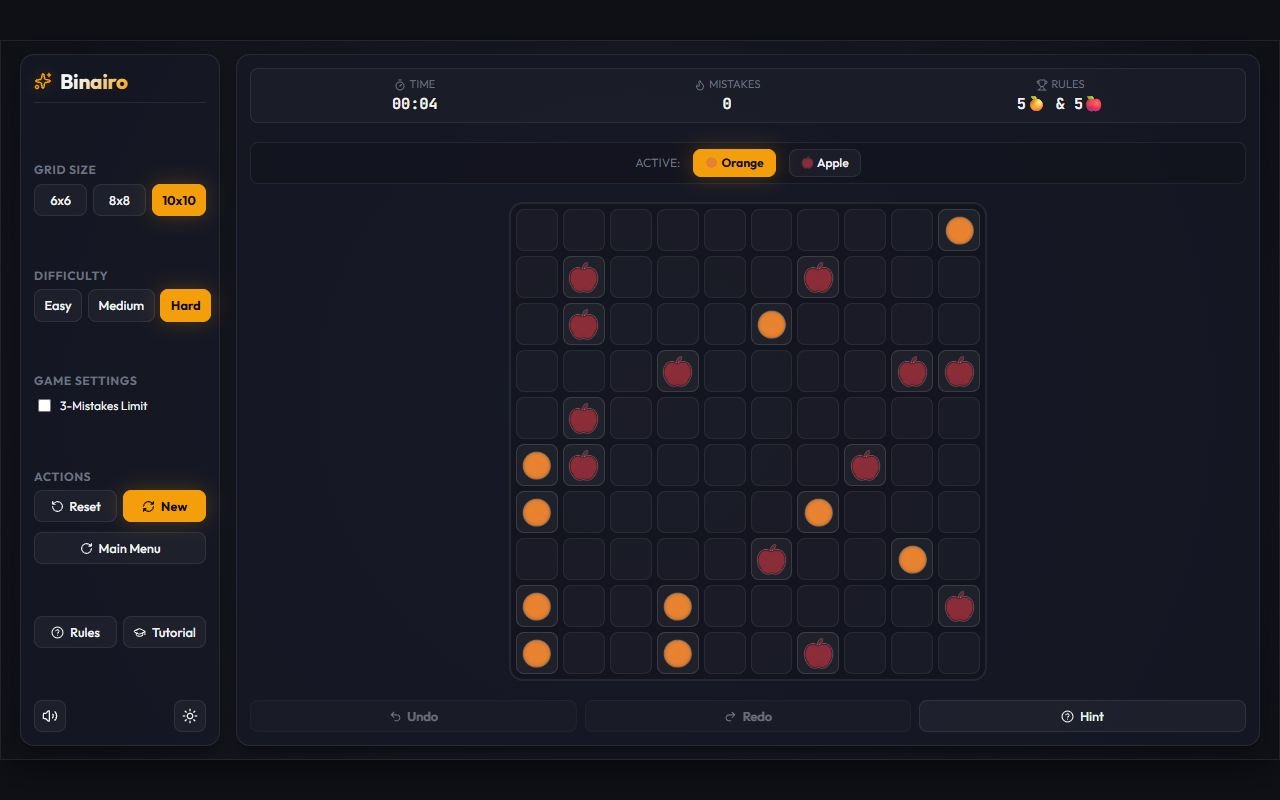
If you're new to the puzzle, start with our beginner's guide to Binairo first. It covers the three rules and the four basic techniques: pairs, sandwiches, counting and no twins.
How the grids and difficulties differ
Each line always needs half oranges and half apples: 3 of each on 6×6, 4 on 8×8, 5 on 10×10. In Fruit Binairo, difficulty decides how much of the grid you start with:
| Difficulty | Fruits given at the start | What to expect |
|---|---|---|
| Easy | About half the grid (e.g. 32 of 64 cells on 8×8) | Pairs, sandwiches and counting are enough |
| Medium | About 40% (e.g. 40 of 100 cells on 10×10) | Mostly basic patterns, with the odd counting squeeze |
| Hard | As few as possible while keeping one solution | You'll need the techniques below |
Every puzzle is generated with exactly one solution, so there is always a logical reason for every fruit. Hard just hides those reasons better.
Technique 1: The one-left squeeze
This is the most useful advanced technique, and the one that unsticks most Hard puzzles.
When a line needs just one more of a fruit, ask: where can that last fruit go without leaving three of the other fruit together? Often it can't go in one of the empty cells, so that cell must be the other fruit.
Here is a row from an 8×8 grid. It needs 4 of each fruit.
| A | B | C | D | E | F | G | H |
|---|---|---|---|---|---|---|---|
| 🍎 | 🍊 | ⬜ | ⬜ | ⬜ | 🍎 | 🍊 | 🍎 |
There are no pairs or sandwiches here. Count instead: the row already has 3 apples and 2 oranges, so the three empty cells need one apple and two oranges. Try the apple in each empty cell:
- Apple in C: 🍎🍊🍎🍊🍊🍎🍊🍎. Fine.
- Apple in D: 🍎🍊🍊🍎🍊🍎🍊🍎. Fine.
- Apple in E: 🍎🍊🍊🍊🍎🍎🍊🍎. Three oranges in B, C and D. Not allowed.
So the apple can't go in E, and E must be an orange 🍊. You don't know C and D yet, but you've gained a cell, and the crossing column may do the rest.
Where to look for it: lines that are nearly full of one fruit, especially when the empty cells are next to that fruit's opposite. The more empties sit in one block, the more likely the squeeze works.
Technique 2: Edge blocks
A close cousin of the squeeze. When a line has a block of four empty cells in a row that must hold three of one fruit and one of the other, the two ends of the block must be the majority fruit.
Why? The single odd fruit has to break up the three. If it sits at either end of the block, the other three are all together. So it must be in one of the two middle cells, and both ends are the majority fruit.
| A | B | C | D | E | F | G | H | |
|---|---|---|---|---|---|---|---|---|
| Before | 🍎 | 🍎 | 🍊 | 🍎 | ⬜ | ⬜ | ⬜ | ⬜ |
| After | 🍎 | 🍎 | 🍊 | 🍎 | 🍊 | ⬜ | ⬜ | 🍊 |
The row has 3 apples and 1 orange, so E to H need three oranges and one apple. E and H are oranges, and the apple goes in F or G.
The same logic works for longer blocks on 10×10 grids. A block of five empty cells that needs four of one fruit and one of the other has only one possible answer: the odd fruit goes dead centre (🍊🍊🍎🍊🍊). And a block of six that needs five of one fruit and one of the other can't be filled at all, so if you ever see one, a fruit placed earlier is wrong.
Technique 3: No twins, on columns too
The third rule, no two rows or columns may be the same, is easy to forget, and on Hard puzzles it's often the only rule that decides a line. It matters most on 6×6 and 8×8, where there are fewer possible lines to choose from.
Use it whenever a row or column has exactly two empty cells and needs one of each fruit. Compare it with every finished line going the same way:
| Column C (finished) | Column F (to solve) | |
|---|---|---|
| Row 1 | 🍊 | 🍊 |
| Row 2 | 🍎 | 🍎 |
| Row 3 | 🍎 | ⬜ |
| Row 4 | 🍊 | 🍊 |
| Row 5 | 🍊 | ⬜ |
| Row 6 | 🍎 | 🍎 |
Column F needs one orange and one apple in rows 3 and 5. An apple in row 3 and an orange in row 5 would make it a copy of column C. So F3 is an orange and F5 is an apple.
Tip: you only compare against lines that are already complete. When you finish a line, take a second to glance at the lines running the same way that are close to finishing.
Technique 4: Cross-checking a cell from both sides
Every cell sits in one row and one column. When the row alone doesn't decide a cell, the column often does, and the two together can decide what neither can alone.
A good habit on big grids: when you find a cell that "could be either" in its row, immediately check its column for a pair, a sandwich, a full count or a squeeze. Solvers who get stuck usually have the answer sitting in the crossing line.
Technique 5: Thinking ahead (without guessing)
Sometimes, on the hardest 10×10 grids, none of the patterns gives you a cell. Then you can test a cell in your head:
- Pick an empty cell in a crowded area, ideally one where either fruit would set off several forced moves.
- Pretend it's an orange. Follow every forced move that follows: pairs, sandwiches, counts.
- If that chain breaks a rule (three in a row, too many of one fruit, or two identical lines), the cell must be an apple.
This is not guessing. You only place a fruit once you've proved the other one is impossible. If the chain doesn't break anything, you've learned nothing, so try another cell rather than committing.
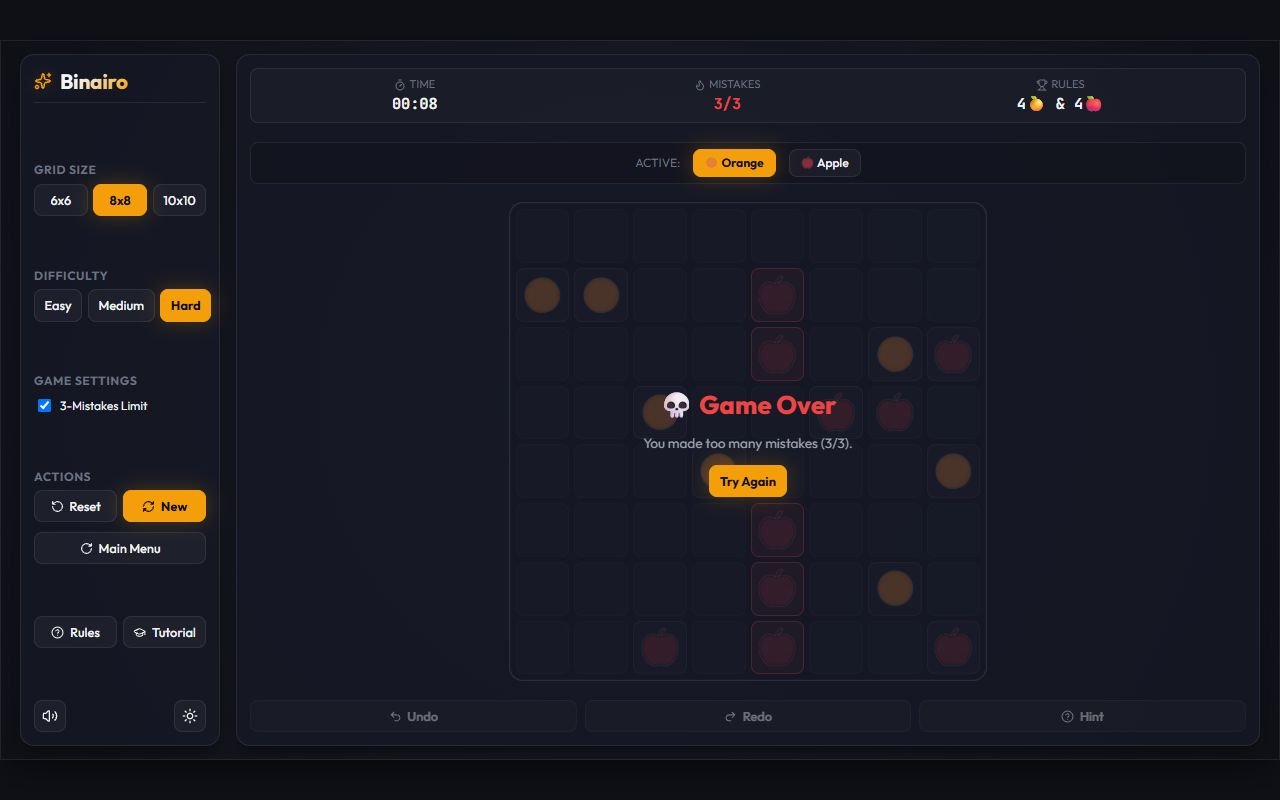
Do this in your head, not on the board. In Fruit Binairo, every wrong fruit you place counts as a mistake immediately, even if it doesn't break a rule yet, and with the 3-Mistakes Limit turned on, three wrong fruits end the puzzle. Short chains of two or three moves are usually enough.
A solving routine for big grids
Big grids reward working in a steady order rather than jumping around:
- First pass, patterns only. Sweep every row, then every column, filling only pairs and sandwiches. Repeat until no more appear. Each new fruit can create a new pair, so keep going.
- Second pass, counting. Look for lines that are full of one fruit, and lines needing just one or two more of one fruit (the squeeze and edge blocks).
- Third pass, no twins. Check lines with two empty cells against finished lines going the same way.
- Go back to step 1 after every new fruit. Advanced moves usually unlock a burst of easy ones.
- Only then think ahead, testing a cell in a crowded area.
Habits that make you faster
- Use right-click on a computer. Left-click places your active fruit and right-click places the other one, so you never switch. It roughly halves the clicks on a 10×10.
- Keep the counts in your head. The stats bar shows how many of each fruit a line needs ("5🍊 & 5🍎" on 10×10). Counting lines quickly is the skill that separates fast solvers from slow ones.
- Work where it's crowded. Lines with few empty cells give answers fastest. Big empty areas solve themselves later.
- Use Undo freely, but not Hint. Undo is free. Hint fills a random cell, so it rarely gives you the cell you're stuck on and it skips the reasoning you're trying to practise.
- Use Reset, not New, if you lose track. It restarts the same puzzle, so you can try a cleaner solving order.
- Play the same size at rising difficulty. Going from 8×8 Medium to 8×8 Hard teaches more than jumping straight to 10×10 Hard.
Quick reference
| Technique | Spot it when... | Then... |
|---|---|---|
| Pair | Two of the same fruit side by side | Both ends are the other fruit |
| Sandwich | Same fruit, one gap between | The gap is the other fruit |
| Counting | A line has half of one fruit | Fill the rest with the other |
| One-left squeeze | A line needs just one more of a fruit | That fruit can't go where it would leave three of the other together |
| Edge block | Four empties in a row need 3 + 1 | Both ends are the majority fruit |
| No twins | A line has two empties left | Don't copy a finished line going the same way |
| Think ahead | Nothing else works | Prove one fruit impossible, place the other |
Ready to put them to work? Open Fruit Binairo, pick 8×8 on Hard, and try to finish without a single hint.