How to Play Binairo (Takuzu): Rules, Beginner Tips and a Fully Solved Example
Binairo is a logic puzzle that takes a minute to learn and a long time to put down. You fill a square grid with two symbols, following three simple rules, until every cell is full. There is no maths and no luck: every puzzle has exactly one answer, and you can always work out the next move.
You might know it by another name. Binairo, Takuzu, Binary Puzzle, Binoxxo, Tic-Tac-Logic and "0h h1" are all the same puzzle. The classic version uses 0s and 1s. In Fruit Binairo, our free browser version, you use oranges 🍊 and apples 🍎 instead.
This guide covers the rules, the four techniques that solve most puzzles, and a real 6×6 puzzle from the game, solved one step at a time.
The three rules of Binairo
Every cell must hold one of the two fruits. A finished grid must follow all three rules:
| Rule | What it means | Example |
|---|---|---|
| 1. No three in a row | You can never have three of the same fruit next to each other, across or down. Two side by side is fine. | 🍊🍊🍎 is fine. 🍊🍊🍊 is not. |
| 2. Equal numbers | Every row and every column has the same number of oranges as apples. | On a 6×6 grid: 3 🍊 and 3 🍎 in every line. On 8×8: 4 of each. On 10×10: 5 of each. |
| 3. No identical lines | No two rows can be exactly the same, and no two columns can be exactly the same. | If row 1 is 🍊🍎🍊🍎🍊🍎, no other row may be. |
That's it. Grids are always even-sized (6×6, 8×8, 10×10) so the second rule can work.
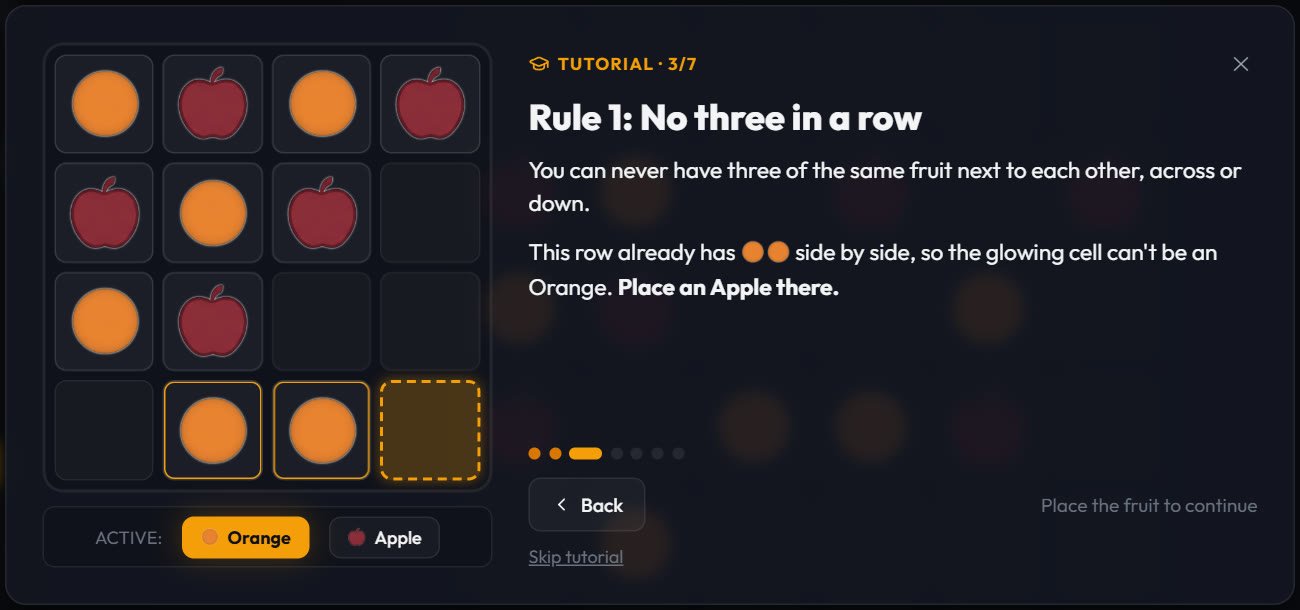
How to play Fruit Binairo
Fruit Binairo runs in your browser on a computer, a phone or a tablet. There is nothing to download and no account.
- Pick a grid size: 6×6, 8×8 or 10×10.
- Pick a difficulty: Easy, Medium or Hard. Easy starts with about half the grid filled in. Hard starts with as few fruits as possible while still keeping a single solution.
- Choose your active fruit with the Orange and Apple buttons above the board, then tap an empty cell to place it. Tap it again with the same fruit to clear it.
- On a computer, right-click places the other fruit, so you never need to switch. Left-click for oranges and right-click for apples (or the other way round) is the fastest way to play.
- The fruits that are there at the start are fixed and can't be changed.
The bar above the board shows your time, your mistakes and how many of each fruit every line needs (for example "3🍊 & 3🍎" on a 6×6 grid). If a line breaks a rule, its fruits light up red.
Helpful buttons:
- Undo and Redo step backwards and forwards through your moves.
- Hint fills one empty cell with the correct fruit.
- Reset clears your moves and restarts the same puzzle. New gives you a fresh puzzle.
- Rules shows the three rules at any time, and Tutorial replays a short interactive lesson on a 4×4 board.
- Turn on the 3-Mistakes Limit in the settings for a harder challenge: three wrong fruits and the puzzle is over.
New to the game? Start with 6×6 on Easy and play the tutorial once. It takes about a minute.
The four techniques that solve most puzzles
You don't need to "see" the whole answer. Almost every move comes from one of these four patterns. Look for them over and over, in rows and columns, and the puzzle solves itself.
1. Pairs: fill both ends
When two of the same fruit sit side by side, the cells on both ends must be the other fruit. Otherwise you would make three in a row.
| Before | After |
|---|---|
| ⬜🍎🍎⬜ | 🍊🍎🍎🍊 |
2. Sandwiches: fill the middle
When the same fruit appears with one gap between them, the gap must be the other fruit.
| Before | After |
|---|---|
| 🍊⬜🍊 | 🍊🍎🍊 |
3. Counting: finish the line
Once a line has all the oranges it needs, every empty cell left in it is an apple, and the other way round. On a 6×6 grid, a row with three apples already has all its apples.
| Before | After |
|---|---|
| 🍎🍊🍎🍎⬜🍊 | 🍎🍊🍎🍎🍊🍊 |
4. No twins: avoid copying a finished line
When a line has only two empty cells left, there are only two ways to fill them. If one way would make it identical to a line that is already finished, the answer is the other way.
| Row | |
|---|---|
| Finished row | 🍊🍎🍊🍊🍎🍎 |
| Row to solve | 🍊🍎🍊⬜⬜🍎 |
| 🍊🍎 in the gaps would copy the finished row, so... | 🍊🍎🍊🍎🍊🍎 |
Pairs and sandwiches find most of your moves. Counting finishes lines off. "No twins" is the rule you need least often, but it is what cracks a stuck grid near the end.
A real puzzle, solved step by step
Here is a Medium 6×6 puzzle from Fruit Binairo. Every line needs 3 oranges and 3 apples.
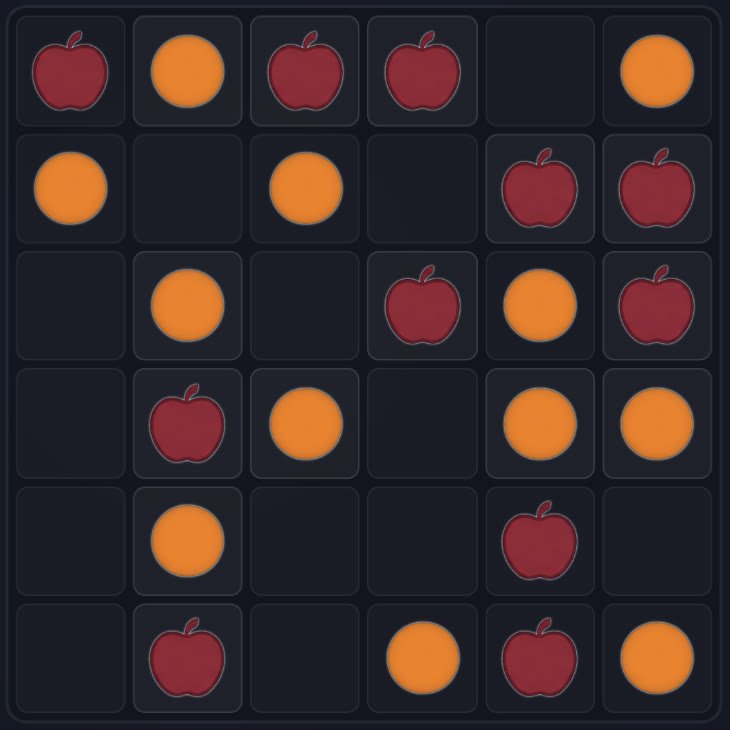
Here is the same board as a grid. Rows are numbered 1 to 6 from the top, and columns A to F from the left.
| A | B | C | D | E | F | |
|---|---|---|---|---|---|---|
| 1 | 🍎 | 🍊 | 🍎 | 🍎 | ⬜ | 🍊 |
| 2 | 🍊 | ⬜ | 🍊 | ⬜ | 🍎 | 🍎 |
| 3 | ⬜ | 🍊 | ⬜ | 🍎 | 🍊 | 🍎 |
| 4 | ⬜ | 🍎 | 🍊 | ⬜ | 🍊 | 🍊 |
| 5 | ⬜ | 🍊 | ⬜ | ⬜ | 🍎 | ⬜ |
| 6 | ⬜ | 🍎 | ⬜ | 🍊 | 🍎 | 🍊 |
Step 1: Count row 1. It already has three apples (A1, C1, D1), so the last empty cell, E1, is an orange 🍊.
Step 2: A sandwich in row 2. B2 sits between two oranges (A2 and C2), so B2 is an apple 🍎.
Step 3: A pair in row 2. E2 and F2 are both apples, so the cell before them, D2, is an orange 🍊. Row 2 is now complete: 🍊🍎🍊🍊🍎🍎.
Step 4: A pair in row 4. E4 and F4 are both oranges, so D4 is an apple 🍎. Row 4 now has three oranges, so by counting A4 is an apple 🍎 too.
Step 5: Count column F. Column F has oranges in F1, F4 and F6. That's three, so the last empty cell, F5, is an apple 🍎.
Step 6: A pair in row 5. E5 and F5 are now both apples, so D5 is an orange 🍊.
Step 7: A sandwich in row 5. C5 sits between two oranges (B5 and D5), so C5 is an apple 🍎. Row 5 now has three apples, so A5 is an orange 🍊.
Here is where we are. Only four cells are left: A3, C3, A6 and C6.
| A | B | C | D | E | F | |
|---|---|---|---|---|---|---|
| 1 | 🍎 | 🍊 | 🍎 | 🍎 | 🍊 | 🍊 |
| 2 | 🍊 | 🍎 | 🍊 | 🍊 | 🍎 | 🍎 |
| 3 | ⬜ | 🍊 | ⬜ | 🍎 | 🍊 | 🍎 |
| 4 | 🍎 | 🍎 | 🍊 | 🍎 | 🍊 | 🍊 |
| 5 | 🍊 | 🍊 | 🍎 | 🍊 | 🍎 | 🍎 |
| 6 | ⬜ | 🍎 | ⬜ | 🍊 | 🍎 | 🍊 |
Step 8: Look at column C. This is the moment beginners often start guessing, because rows 3 and 6 each need one orange and one apple and both ways look possible. But look down column C: C2 and C4 are both oranges, with C3 between them. That's a sandwich, so C3 is an apple 🍎.
Step 9: Finish off. Row 3 now needs one more orange, so A3 is an orange 🍊. Column A then has three oranges, so A6 is an apple 🍎, and column C needs one more orange, so C6 is an orange 🍊.
Solved:
| A | B | C | D | E | F | |
|---|---|---|---|---|---|---|
| 1 | 🍎 | 🍊 | 🍎 | 🍎 | 🍊 | 🍊 |
| 2 | 🍊 | 🍎 | 🍊 | 🍊 | 🍎 | 🍎 |
| 3 | 🍊 | 🍊 | 🍎 | 🍎 | 🍊 | 🍎 |
| 4 | 🍎 | 🍎 | 🍊 | 🍎 | 🍊 | 🍊 |
| 5 | 🍊 | 🍊 | 🍎 | 🍊 | 🍎 | 🍎 |
| 6 | 🍎 | 🍎 | 🍊 | 🍊 | 🍎 | 🍊 |
Every row and column has three of each fruit, there are no three in a row anywhere, and no two rows or columns match. Notice that every single move came from just pairs, sandwiches and counting. No guessing at all.
Beginner mistakes to avoid
- Only looking at rows. Half your moves are hiding in the columns. After every move, check the column you just changed as well as the row.
- Guessing when you're stuck. In Fruit Binairo, a wrong fruit adds to your mistake counter straight away, even if it doesn't break a rule yet. If you can't find a move, scan every line again for pairs and sandwiches, then count. There is always a logical next step.
- Forgetting to count. It's easy to miss that a line is "full" of one fruit. The "3🍊 & 3🍎" reminder in the stats bar is there to help.
- Ignoring the third rule. Near the end of bigger grids, "no identical lines" is often the only thing that decides the last few cells.
Frequently asked questions
Is Binairo the same as Takuzu? Yes. Binairo, Takuzu, Binary Puzzle, Binoxxo and 0h h1 are different names for the same puzzle with the same three rules. Some versions use 0 and 1, others X and O, colours, or, in Fruit Binairo, oranges and apples.
Do I ever need to guess? No. Every Fruit Binairo puzzle is generated with exactly one solution, so there is always a reason for the correct fruit in each cell. On big Hard grids the reasons get harder to spot. Our advanced Binairo strategy guide covers the techniques for those.
Which grid size should I start with? Start with 6×6 on Easy. Once you can finish it without the Hint button, try 6×6 Medium, then 8×8. 10×10 on Hard is the real test.
Is Binairo good for your brain? It's a great way to practise logical thinking, pattern spotting and patience. Like Sudoku, it rewards slow, careful reasoning over speed.
Can I play on my phone? Yes. Fruit Binairo works in any modern browser on Android and iPhone, as well as on Windows, Mac and Chromebook. Turn your phone sideways: the game is laid out for landscape and asks you to rotate if you hold it upright.
Quick checklist
- Look for pairs 🍎🍎 and fill both ends with the other fruit.
- Look for sandwiches 🍊⬜🍊 and fill the middle.
- Count every line: once it has half of one fruit, fill the rest with the other.
- With two cells left in a line, make sure it won't copy a finished line.
- Check rows and columns after every move.
- Never guess.
Ready to try it? Fruit Binairo is free in your browser, with grids from a quick 6×6 to a tough 10×10.