How to Play Klondike Solitaire: Rules, Scoring and Strategy Tips to Win More Games
Klondike is the solitaire most people mean when they say "solitaire". It is the one that came free with Windows, the one your grandparents played with a real deck at the kitchen table, and still one of the best ways to spend ten quiet minutes. The rules take five minutes to learn. Winning often takes a bit longer.
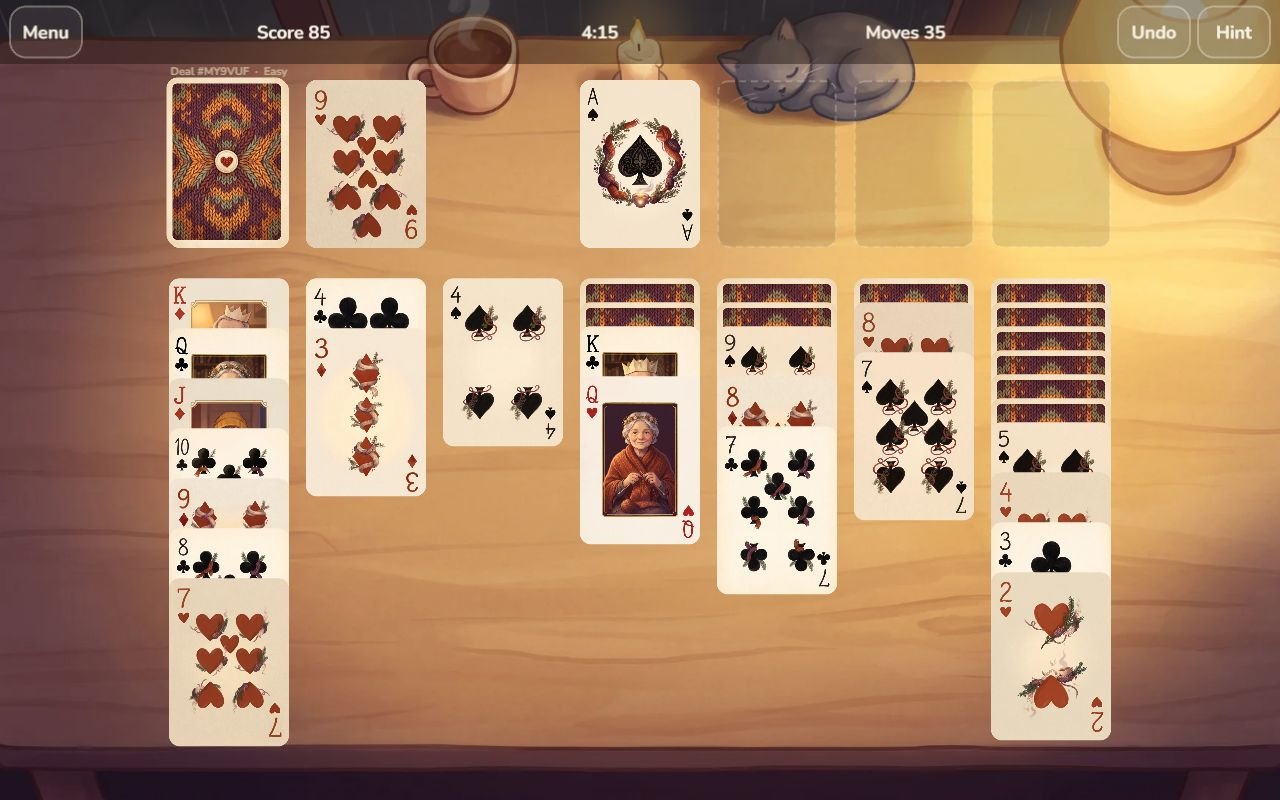
This guide covers the layout, the full rules, how to play our free version, Klondike Solitaire, how its scoring works, and the strategy that turns a coin-flip game into a game you win most of the time.
The layout: tableau, stock, waste and foundations
A game of Klondike uses one standard 52-card deck, with no jokers. The cards are dealt into four areas:
| Area | Where it is | What it holds |
|---|---|---|
| Tableau | The seven columns across the middle | 28 cards. Column 1 has one card, column 2 has two, and so on up to seven in column 7. Only the top card of each column starts face up. |
| Stock | Top left | The other 24 cards, face down. You turn these over during the game. |
| Waste | Next to the stock | The cards you turn over from the stock. Only the top one can be played. |
| Foundations | Top right | Four empty piles, one per suit. This is where you are trying to put every card. |
That means 21 cards start hidden in the tableau. Turning those face-down cards over is what most of the game is about.
Klondike solitaire rules
The goal is to move all 52 cards onto the four foundations, one suit per pile, in order from ace up to king.
Building on the foundations
- An empty foundation can only take an ace.
- After that, each foundation takes the next card of the same suit: the 2 of hearts on the ace of hearts, then the 3 of hearts, and so on up to the king.
Building in the tableau
- A card can go on a card one rank higher of the opposite colour. A red 6 goes on a black 7. A black jack goes on a red queen.
- A run of face-up cards in that order (for example black 9, red 8, black 7) can be moved together as one unit.
- When you move the last face-up card off a column, the face-down card underneath turns face up.
- Only a king, or a run that starts with a king, can go into an empty column.
The stock and waste
- Tap the stock to turn cards onto the waste: one at a time in Draw 1, or three at a time in Draw 3. In Draw 3 only the top card of the three can be played.
- The top waste card can go to the tableau or to a foundation.
- When the stock is empty, tap it again to turn the waste back over and go through it again. How many times you can do this depends on the scoring mode (more on that below).
You can also take a card back down from a foundation onto the tableau if it helps. That is legal, but in standard scoring it costs points.
The game is won when all four foundations run from ace to king.
How to play Klondike Solitaire on PixelsMaya
Klondike Solitaire runs in your browser on a computer, a tablet or a phone. There is nothing to download and no account. It is set on a warm wooden table on a rainy evening, with cream paper cards and soft sounds, so it is built for a calm game rather than a race.
The title screen has five buttons: Continue (if you have a game in progress), New Deal, Daily Deal, Statistics and Settings.
Moving cards
- Tap or click a card to send it to the best spot. The game tries a foundation first, then a tableau column, and it prefers a column with cards in it over an empty one.
- Drag a card to put it exactly where you want. Tap or drag a face-up card in the middle of a column to move it together with all the cards on top of it. While you drag, the piles that can legally take the cards are highlighted.
- Tap the stock to draw. When it is empty, tap it again to turn the waste over (if your rules allow another pass).
Buttons and keys
| Control | What it does |
|---|---|
| Undo (or Ctrl+Z / Cmd+Z) | Takes back your last move. You can keep pressing it to step further back. Your score goes back too. |
| Hint (or H) | Highlights a sensible next move. If there isn't one, it tells you whether you are stuck or just out of helpful ideas. |
| Space | Draws from the stock. |
| Menu (or Esc) | Pauses the game and opens the menu: Resume, New Deal, Daily Deal, Replay This Deal, Statistics, Settings and Main Menu. |
| Finish ✓ | Appears when the stock is empty and every tableau card is face up, and the game has checked that the rest really can be played out. Press it and the cards fly home on their own. |
The bar along the top shows the deal number, your score, your moves and the time.
Settings
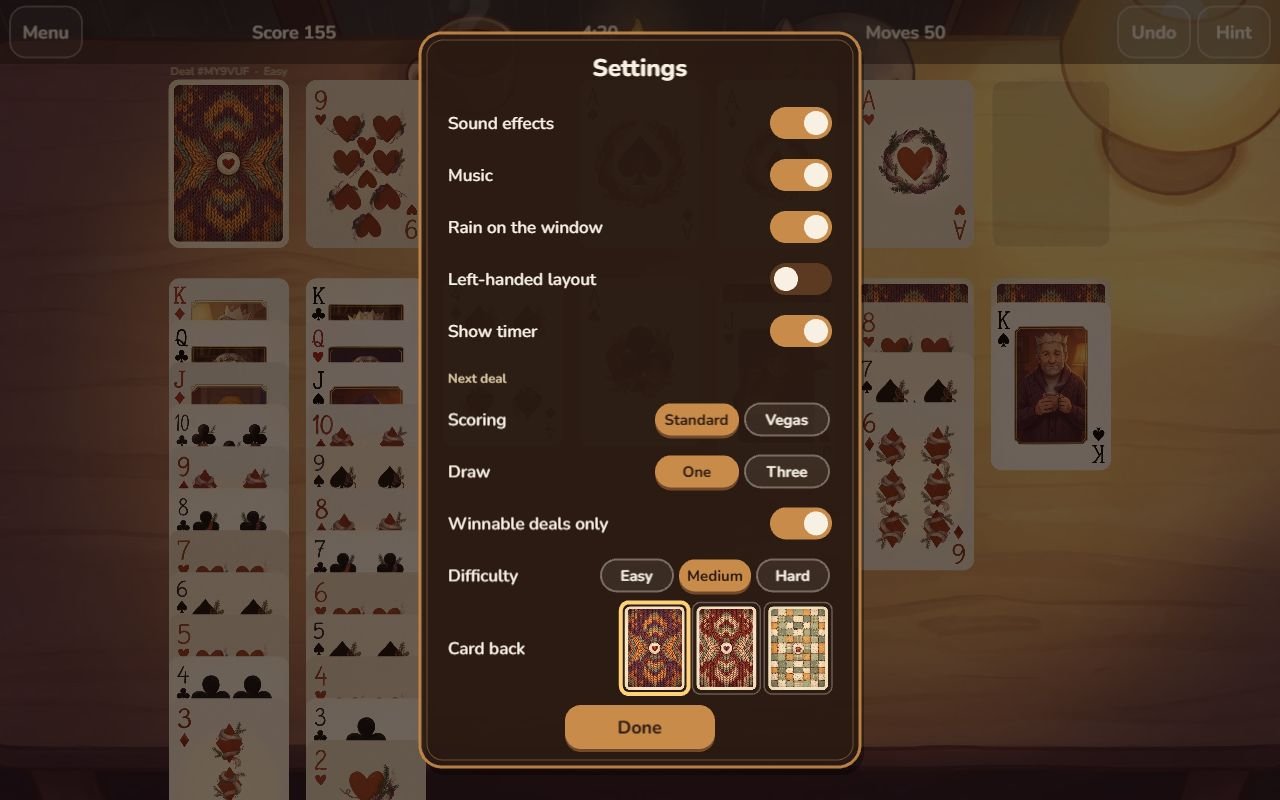
In Settings you can turn on or off Sound effects, Music, Rain on the window (a gentle rain ambience), a Left-handed layout and Show timer, and choose one of three painted card backs.
The Next deal section sets the rules for your next new game:
- Scoring: Standard or Vegas.
- Draw: One or Three.
- Winnable deals only: on by default.
- Difficulty: Easy, Medium or Hard (used while winnable deals are on).
Are the deals winnable?
Yes, by default. With Winnable deals only switched on, every new deal comes from a list of deals that the game's built-in solver has already proven can be won under your exact rules: your draw count and your scoring mode, including the Vegas limit on passes through the stock. Each deal in the list was played all the way to a win before it was kept.
The Difficulty setting picks how much planning a deal needs:
| Difficulty | What it means |
|---|---|
| Easy | If you press Hint and do what it says every time, you will win. |
| Medium | Hints alone get stuck, but a little planning finds the win. |
| Hard | The win is there, but it takes real planning or careful use of Undo. |
Turn Winnable deals only off if you want classic random shuffles, where some deals cannot be won by anyone.
The Daily Deal is the same deal for every player on a given day, and it is always winnable in both Draw 1 and Draw 3 with standard scoring (the check doesn't cover the Vegas limit on passes). A tick appears next to it once you have won it. Replay This Deal in the menu restarts the deal you are on, which is handy for trying a different line.
The game saves as you play, so you can close the tab and come back to the same deal later on the same device.
Scoring: standard vs Vegas
Standard scoring
Standard scoring follows the classic Windows rules:
| Move | Points |
|---|---|
| Waste card to the tableau | +5 |
| Waste card to a foundation | +10 |
| Tableau card to a foundation | +10 |
| Turning over a face-down tableau card | +5 |
| Foundation card back to the tableau | −15 |
| Turning the waste back into the stock | −100 in Draw 1, −20 in Draw 3 |
Your score never drops below zero. You can go through the stock as many times as you like.
When you win, you also get a time bonus of 700,000 divided by the number of seconds you took, as long as the game lasted at least 30 seconds. Win in 5 minutes (300 seconds) and that is a 2,333-point bonus. Win in 10 minutes and it halves. Speed matters a lot in standard scoring.
Vegas scoring
Vegas scoring treats the game like a bet:
- You start at −52, the "buy-in" of one point per card.
- Every card you put on a foundation earns +5. Taking a card back off a foundation loses 5.
- Passes through the stock are limited: one pass in Draw 1 (no turning the waste over at all) and three passes in Draw 3.
Get all 52 cards home and you finish on +208. Anything above zero means you "made money" on the deal, even if you didn't win it. Vegas is a great mode for practising careful play, because every card you turn over from the stock might be the last time you see it.
Statistics
Statistics keeps a separate record for each of the four modes (Draw 1 or Draw 3, Standard or Vegas): games played, games won and win percentage, your current and best winning streak, best time, best score and fewest moves.
Solitaire strategy: tips to win more games
Klondike rewards patience. Most lost games are not bad luck. They are lost in the first twenty moves, by playing the obvious card instead of the useful one. These are the habits that make the biggest difference.
1. Uncover face-down cards first
The 21 hidden cards in the tableau are the whole puzzle. Every move that turns one over gives you new information and new options. When you have a choice, pick the move that flips a face-down card.
Better still, work on the columns with the most hidden cards. Column 7 starts with six cards face down. Freeing it early opens up far more of the game than clearing column 2.
2. Prefer tableau moves over drawing from the stock
The stock is not going anywhere. Before you tap it, look at the tableau for any move that turns a card over or tidies up a run. Drawing first can bury the card you need and, in Vegas or Draw 3, cost you a chance you won't get back.
A simple order of priority:
- Play aces and twos to the foundations.
- Make tableau moves that turn over a face-down card.
- Make tableau moves that set up the next flip.
- Only then, draw from the stock.
3. Play aces and twos straight away
An ace or a 2 can never hold anything useful in the tableau (nothing can go on top of a 2 except an ace, and aces go home). Send them to the foundations as soon as you see them.
4. Don't rush other cards to the foundations
Beyond the aces and twos, slow down. A red 6 on a foundation can't hold a black 5 in the tableau any more. If you build one suit up quickly while the others lag behind, you can strand cards with nowhere to go.
A good rule of thumb: only move a card to a foundation when you won't need it to hold a lower card of the other colour. Middle cards, roughly fives to eights, are the ones most often needed in the tableau. Keep the foundations growing fairly evenly.
5. Only empty a column when you have a king to fill it
An empty column can only take a king. That makes it valuable, but only if you have a king ready. Emptying a column with no king in sight wastes moves and can break up runs you need.
When you do fill one, choose the king carefully. If you have a red queen waiting, a black king is the one to use. Prefer a king that has face-down cards underneath it, because moving it uncovers something new.
6. Break up runs only for a reason
Sometimes moving just the bottom part of a run uncovers a card that can go to a foundation, or lets you shift cards between columns. That is a good reason. Splitting a run just because you can usually leaves you with two messy columns instead of one tidy one.
7. Use Undo to explore
In this version Undo is free and also rolls back your score. If you are unsure between two lines, try one, look at what turns up, and undo if it goes nowhere. On Hard deals, this is part of the game.
Draw 3 tips
Draw 3 is the traditional, harder game. You see only every third card on each pass, so the order of the stock matters a lot.
- Know that the stock shifts. If you play a card from the waste, every card after it moves up one position. On the next pass, different cards will come to the top. Sometimes playing a waste card unlocks a card you need. Sometimes leaving it in place keeps a useful card on top.
- Watch the first pass closely. On your first trip through the stock, note which cards are on top of each group of three. Those are the cards you can reach without changing anything.
- Don't play from the waste just because you can. If the tableau has a move that flips a card, do that first, then decide whether a waste play helps.
- In standard scoring, remember the cost. Each pass costs 20 points in Draw 3 (and 100 in Draw 1), so it pays to plan rather than cycle through blindly.
- In Vegas, you only get three passes. Treat the last pass as precious and make every waste play count.
Frequently asked questions
What are the basic Klondike solitaire rules? Build four foundations from ace to king, one per suit. In the seven tableau columns, place cards in descending order with alternating colours (red on black, black on red). Only kings can go into empty columns. Turn cards from the stock when you run out of tableau moves. You win when all 52 cards are on the foundations.
What is the difference between Draw 1 and Draw 3? In Draw 1 you turn one card from the stock at a time, so you can reach every card on every pass. In Draw 3 you turn three at a time and can only play the top one, so many cards stay out of reach until the order shifts. Draw 1 is easier and more relaxed. Draw 3 is the traditional, harder rule set.
What are the odds of winning Klondike solitaire? It depends a lot on the rules and how you play. Computer studies that let a solver see every card suggest that a large majority of Draw 1 deals, roughly eight in ten, can be won in theory. Real players can't see the face-down cards, so their win rates are lower, and Draw 3 is harder still. In our version you don't have to worry about it: with Winnable deals only on, every deal has been proven winnable.
Is every game of solitaire winnable? No. Some random shuffles cannot be won no matter how you play, for example when key cards are buried in the wrong order. That is why our game checks each deal with a solver first. Switch Winnable deals only off if you want truly random deals.
How does Vegas solitaire scoring work? You start at −52 and earn 5 points for each card you put on a foundation, so a full win scores 208. You get one pass through the stock in Draw 1 and three in Draw 3.
Is this free solitaire online? Yes. Klondike Solitaire is free in your browser with no download, no account and no purchases. It works on Windows, Mac, Chromebook, Android and iPhone.
Quick checklist
- Play aces and twos to the foundations straight away.
- Look for a move that turns over a face-down card before anything else.
- Work on the longest columns first.
- Check the tableau before drawing from the stock.
- Don't rush fives to eights onto the foundations.
- Only empty a column when a king is ready, and pick the king of the right colour.
- In Draw 3, remember that playing a waste card shifts the whole stock.
- When unsure, try a line and undo if it fails.
If you enjoy a calm logic game, try our guides on how to play Binairo and how to play Sudoku next.
Ready to deal? Play Klondike Solitaire free in your browser, with Draw 1 or Draw 3, standard or Vegas scoring, and a winnable Daily Deal every day.
Ready to play Klondike Solitaire?
Free in your browser — no download, no account.
▶ Play Klondike Solitaire