Meowdoku vs Sudoku vs Star Battle vs Queens: What's the Difference?
Open Finding Meow for the first time and you will probably think "cat Sudoku". The name Meowdoku invites it. But place two cats and you will notice the game has very little to do with filling in digits. It belongs to a different family of grid puzzles, the one that includes Star Battle and the daily Queens puzzle, and knowing that changes how you play it.
This guide puts the four puzzles side by side: what the rules actually are, what makes each one hard, which habits transfer between them, and which to try next if you like one of them.
The four puzzles at a glance
| Sudoku | Meowdoku (Finding Meow) | Star Battle | Queens | |
|---|---|---|---|---|
| What you place | A digit in every cell | One cat per region | One or two stars per region | One queen per region |
| Grid | 9×9, split into nine 3×3 boxes | 5×5 to 9×9, split into irregular coloured regions | Usually 8×8 to 14×14, irregular regions | Usually 7×7 to 11×11, irregular coloured regions |
| Row and column rule | Each digit 1 to 9 once per row, column and box | Exactly one cat per row and column | Exactly one (or two) stars per row and column | Exactly one queen per row and column |
| Touching rule | None | Cats can't touch, even diagonally | Stars can't touch, even diagonally | Queens can't touch, even diagonally |
| Given clues | 17 to 30 digits filled in | One or two cats pre-placed on every board | None | None |
| Cells filled at the end | All 81 | 5 to 9 cats | 8 to 28 stars | 7 to 11 queens |
Read down the Meowdoku, Star Battle and Queens columns and you will see they are the same puzzle. Meowdoku is a one-star Star Battle with irregular coloured regions, and Queens is the same thing with a crown instead of a cat. Sudoku is the odd one out.
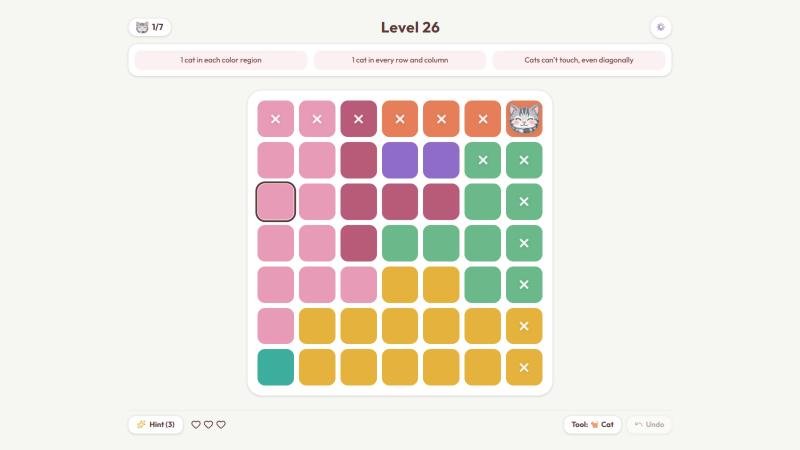
Meowdoku vs Sudoku
The only thing the two share is the "one per row, one per column" idea, and even that works differently.
- Sudoku fills the grid. Every one of the 81 cells ends up with a digit, and the puzzle is about which digit goes where. Meowdoku leaves most cells empty. On a 7×7 board you place 7 cats and the other 42 cells stay blank.
- Sudoku has no adjacency rule. Two cells next to each other can hold any two different digits. In Meowdoku the eight cells around a cat must be empty, and that single rule does most of the solving work.
- Sudoku's boxes are fixed. The nine 3×3 boxes are always in the same place. Meowdoku's regions are a different shape on every board, so reading the regions is the puzzle.
- Sudoku clues are digits; Meowdoku clues are shapes. A Sudoku starts with digits filled in and you deduce from them. A Meowdoku board can start almost empty, because the region shapes alone are enough to force a single answer. Finding Meow gives you one or two cats at the start to get you going, but the logic lives in the colours.
What transfers: the discipline of marking candidates and never guessing. A Sudoku player's habit of pencilling in possibilities is exactly the X-mark habit that wins at Meowdoku. The specific Sudoku techniques (naked pairs, X-wings, swordfish) do not transfer, because they are about digits competing for cells.
Which is harder? A hard Sudoku takes longer and has more cells to track. A hard Meowdoku is quicker but more spatial, and it punishes guessing more directly, since Finding Meow takes a heart for every wrong cat. If you find Sudoku dry, Meowdoku is the better fit; if you want a 20-minute sit-down puzzle, Sudoku is.
Meowdoku vs Star Battle
Star Battle is the pencil-and-paper puzzle that Meowdoku grew out of. The rules are identical in the one-star version: one star per region, row and column, no two stars touching. Finding Meow adds cats, colours and a friendlier size range, and that is the whole difference.
The famous version of Star Battle is two-star, where every region, row and column needs exactly two stars. That changes the puzzle in ways worth knowing before you try it:
- Counting matters more. With two stars per row, a region that spans three rows has to share them with other regions, and you spend a lot of time working out how many stars a group of rows can hold.
- Regions are bigger and grids are larger. 10×10 two-star is the standard competition size, and 14×14 three-star exists.
- There are no pre-placed stars. You start from an empty grid every time.
The five techniques in our Finding Meow strategy guide (free cats, squeezed regions, owned lines, region pairs and the cat that would block its neighbour) are standard one-star Star Battle techniques under other names. Learn them in Finding Meow and you can pick up a one-star Star Battle immediately. Two-star needs those plus counting, so treat Finding Meow's 8×8 and 9×9 boards as the step before it.
Meowdoku vs Queens
If you play the daily Queens puzzle on your phone, you already know how to play Finding Meow. The rules are identical: one queen per coloured region, row and column, and no two queens touching, including diagonally. Swap the crown for a cat and you have Meowdoku.
The differences are in the packaging:
| Queens | Finding Meow | |
|---|---|---|
| Puzzles | One per day | 50 Journey levels plus endless Classic boards |
| Grid sizes | Changes daily, often 8×8 to 10×10 | You pick: 5×5 to 9×9 |
| Marking | Tap once for an X, twice for a queen | Tap or click once for an X, twice for a cat |
| Mistakes | Shown at the end, or flagged as you go | A wrong cat costs one of three hearts straight away |
| Help | None | Three hints per puzzle, undo, auto-save |
| Start | Empty grid | One or two cats pre-placed on every board |
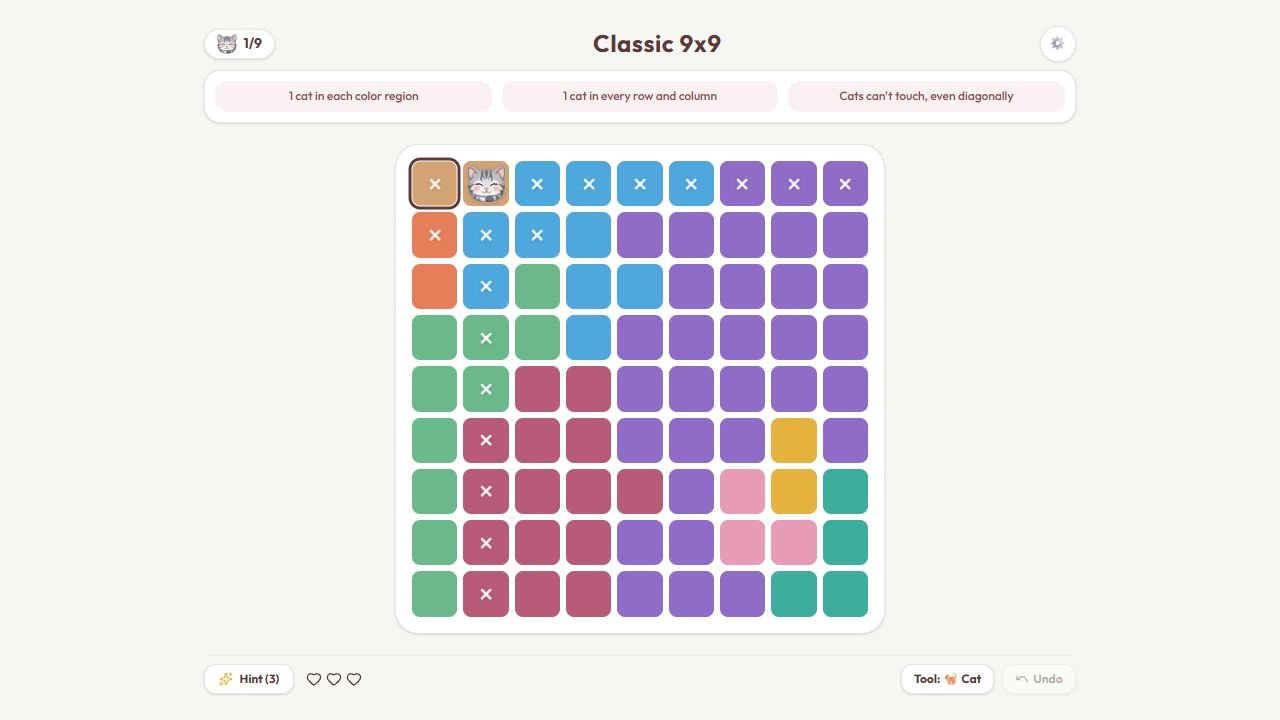
Because Finding Meow checks each cat the moment you place it, it is a stricter trainer: you cannot fill the board on a hunch and tidy up later. That makes it a good place to practise the deductions that get your Queens time down. The Level 26 walkthrough in the strategy guide is, step for step, how an experienced Queens solver reads a board.
Which puzzle is the hardest?
It depends on the kind of hard you mean.
- Most to keep track of: Sudoku. Eighty-one cells, nine candidates each.
- Deepest logic: two-star Star Battle. Large grids, counting arguments, no clues.
- Fastest to punish a guess: Finding Meow, because of the hearts.
- Easiest to learn: Meowdoku and Queens, in that order. Finding Meow's Spring Garden chapter teaches the rules on 5×5 boards in a few minutes; Queens drops you straight onto a full-size grid.
Which should you play next?
- You like Sudoku and want something different: play Finding Meow's Journey mode from Level 1. The one-per-row habit is already yours; the rest is new.
- You play Queens every day and want more: Finding Meow's Classic mode at 8×8 or 9×9 gives you an unlimited supply of the same puzzle.
- You have finished Finding Meow's 50 levels: look for two-star Star Battle. It is the natural next step and everything you know still applies.
- You want a quick logic fix that is neither: try Fruit Binairo, a different kind of grid puzzle with three rules and no regions at all, or our other free puzzle games.
Frequently asked questions
Is Meowdoku a type of Sudoku? Not really. It borrows the one-per-row-and-column idea, but it has an adjacency rule, irregular regions and only one piece per region. It is a Star Battle variant with cats.
Are Meowdoku and Queens the same puzzle? Yes. One cat or queen per region, row and column, none touching. The grids, clues and scoring differ, but the logic is identical.
What is the difference between one-star and two-star Star Battle? One-star needs exactly one star in every region, row and column, which is the Meowdoku rule set. Two-star needs exactly two in each, which adds counting arguments and is noticeably harder.
Can I use Sudoku techniques in Meowdoku? The general habits transfer: mark candidates, never guess, re-scan after every placement. Named Sudoku techniques do not, because Meowdoku is not about digits.
Does every Finding Meow board have one solution? Yes. Every Journey level and every Classic board is generated with a single solution and checked before it is shown, so logic alone is always enough.