Wood Block Sudoku Strategy Guide: How Scoring Works and How to Get a High Score
Wood Block Sudoku mixes a classic block puzzle with a Sudoku grid. You drag wooden shapes onto a 9×9 board, and any full row, full column or full 3×3 square clears away. There is no timer and no luck in how the board behaves, only in which shapes you're given. The game ends when none of your shapes will fit.
This guide covers how to play, exactly how scoring works (with the game's real numbers), and the block sudoku strategy that turns a 2,000-point game into a 20,000-point one.
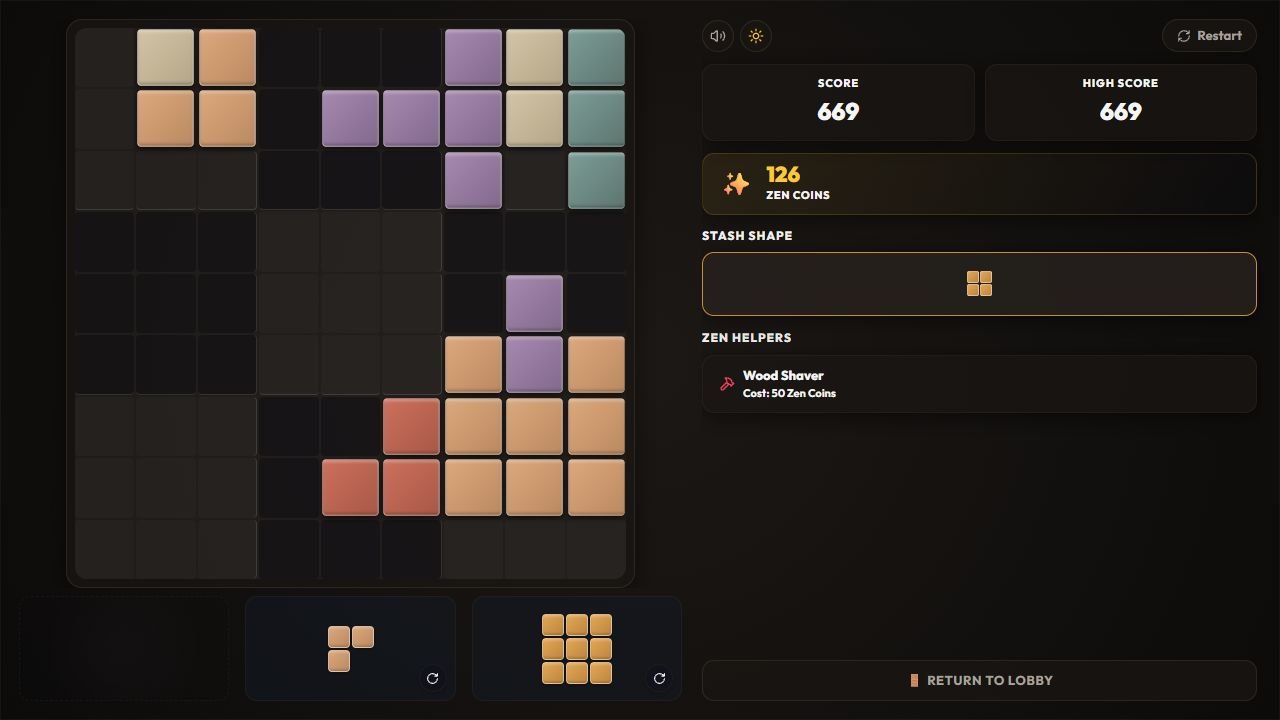
How to play Wood Block Sudoku
Wood Block Sudoku runs in your browser on a computer, phone or tablet, with no download or account. It's built for a wide screen, so on a phone, turn it sideways.
- Press Begin Journey on the menu. You start with an empty 9×9 board and three shapes in the tray underneath.
- Drag a shape onto the board. While you drag, the cells it would cover light up to show whether it fits. The shape floats a little above your finger or cursor, so you can see where it's going.
- Let go to place it. If it doesn't fit, it bounces back to the tray.
- Place all three shapes and three new ones appear.
- Any full row, full column or full 3×3 square clears instantly.
- When none of the shapes in your tray can fit anywhere, it's No Moves Left and the game is over.
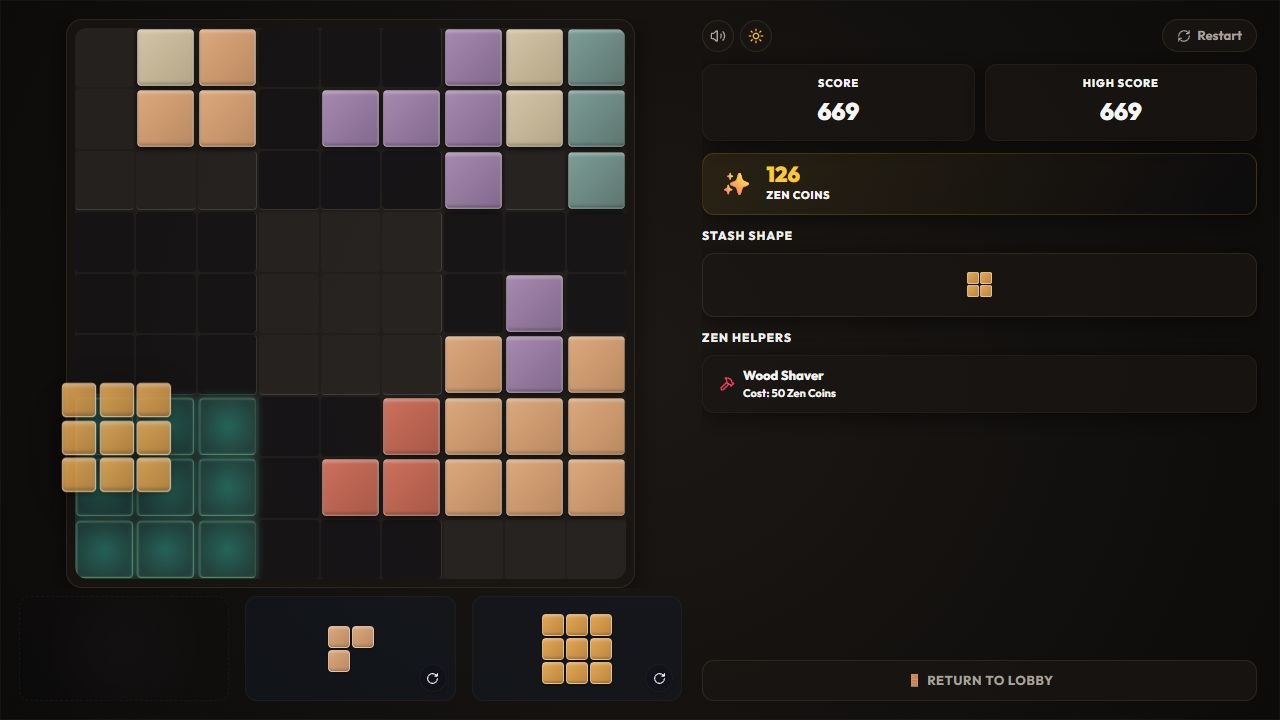
Three extra tools make this more than a standard block puzzle:
- Rotate: tap the small arrow in the corner of any shape in the tray to turn it 90° clockwise. It's free, and you can rotate as often as you like.
- Stash Shape: drag a shape into the stash pocket on the right to keep it for later. Drag it back onto the board when you need it. If the stash is already full, dropping a new shape on it swaps the two. Tapping the stash pocket stores the first shape in your tray, or swaps it with what's already there.
- Wood Shaver: spend 50 Zen Coins to remove a single tile from the board. Tap the Wood Shaver, then tap the tile you want gone.
The panel on the right shows your Score, your High Score and your Zen Coins. There's also a Restart button, sound and theme buttons, and Return to Lobby. Your board saves automatically, and the game pauses if you switch to another window.
How scoring works
Every point comes from two sources.
1. Placing a shape: 1 point per tile. A single dot is worth 1 point. A 3×3 square is worth 9.
2. Clearing: a bonus that grows with every extra line. A row, a column and a 3×3 square each count as one "line" here. The more you clear with a single shape, the bigger the bonus:
| Lines cleared at once | Bonus | Per line |
|---|---|---|
| 1 | 100 | 100 |
| 2 | 300 | 150 |
| 3 | 600 | 200 |
| 4 | 1,000 | 250 |
| 5 | 1,500 | 300 |
The formula is simple: for n lines, you score 100 × (1 + 2 + … + n). That is the single most important fact in the game.
Two singles are worth 200. One double is worth 300. A triple beats three singles by 300 points. Every high score is built on clearing several lines with one piece.
There is no streak bonus between turns, so clearing on every move doesn't multiply anything. It's all about how much a single placement clears.
Rows, columns and squares all count
Because 3×3 squares clear too, one placement can finish more than one type of line at once. A row and a column that cross both count. A row and the 3×3 square it passes through both count. Fill the last gap where a full row, a full column and a full square all meet and that's a triple: 600 points from one tile.
Zen Coins and the Wood Shaver
You earn Zen Coins two ways:
- +1 coin for every tile you place.
- When you clear: the number of tiles cleared, multiplied by the number of lines cleared.
| Clear | Tiles removed | Lines | Coins from the clear |
|---|---|---|---|
| One row | 9 | 1 | 9 |
| A row and the square it runs through | 15 | 2 | 30 |
| A row and a column crossing | 17 | 2 | 34 |
| Two rows | 18 | 2 | 36 |
| Three rows | 27 | 3 | 81 |
So multi-line clears pay out in coins as well as points. A good triple can earn you a Wood Shaver use in one go.
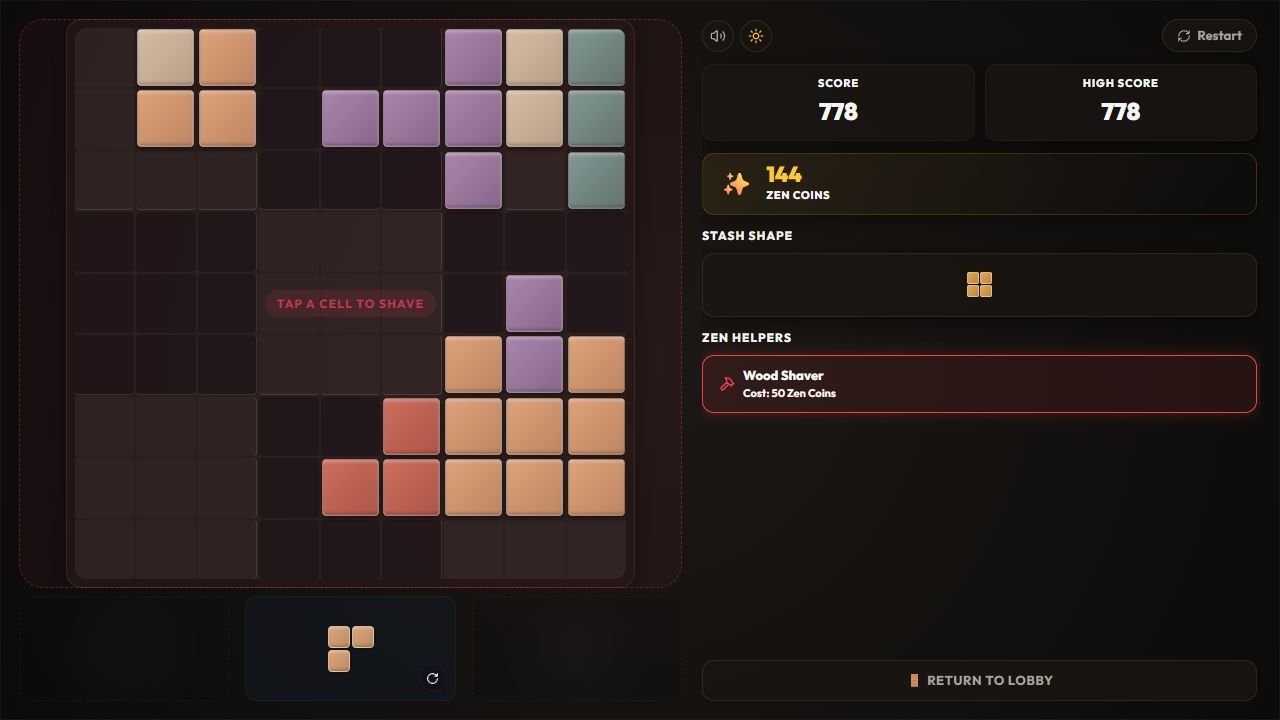
The Wood Shaver costs 50 coins and removes one tile. Removing a tile never clears a line by itself, so don't think of it as a scoring tool. It's an escape tool: use it to open a gap so a stuck piece fits, or to fix a single hole you can't fill.
The shapes you'll see
Every shape is picked at random from a set of 27, so you can get the same shape more than once in a set of three.
| Shape | Tiles | Variations |
|---|---|---|
| Dot | 1 | 1 |
| Straight line | 2, 3, 4 or 5 | Each length comes flat and upright |
| 2×2 square | 4 | 1 |
| 3×3 square | 9 | 1 |
| Small corner (3 tiles in a 2×2) | 3 | 4 orientations |
| Big L (5 tiles in a 3×3) | 5 | 4 orientations |
| T (5 tiles in a 3×3) | 5 | 4 orientations |
| Z and S | 4 | 3 versions |
| Plus | 5 | 1 |
The pieces to fear are the 3×3 square (needs a completely empty 3×3 area), the five-long lines (need five empty cells in a straight run) and the big L, T and plus shapes, which all need a 3×3 footprint.
The most important rule: how the game decides you've lost
This catches out a lot of players, so it's worth knowing exactly how it works.
After every placement, the game checks whether any shape in your tray fits anywhere on the board, as it's currently turned. If not, the game ends straight away.
That has three big consequences:
- Rotation doesn't save you automatically. If a long line only fits upright but is lying flat in your tray, and nothing else fits, the game is over. You don't get a chance to turn it first.
- The stash doesn't count. A shape sitting in your stash is not checked. Even if it would fit perfectly, if nothing in the tray fits, it's game over.
- Rotating can end the game. Turning a piece into a position where it doesn't fit, when no other tray piece fits either, ends the game. Before you rotate, check that something will still fit.
So: before you place your second piece of a set, look at the shape you'll have left. Make sure it fits as it's turned right now, and if not, rotate it while you still have other moves available.
Strategy for a high score
1. Keep the board open
Your first job is staying alive. A board that's half full will eventually give you a 3×3 square with nowhere to go. Aim to keep large, unbroken empty areas, ideally at least one empty 3×3 space and some long open rows.
When you're choosing where to put a piece, ask: "Where will this hurt my space least?" rather than "Where does it fit?"
2. Build along the edges and corners first
Pieces placed against the edges and in corners leave the middle open. The middle is the most flexible area: a 3×3 square, a plus or a five-long line can go there in lots of ways. Fill your outer rows and columns first and keep the centre for awkward shapes.
3. Look at all three shapes before you move
You always see all three shapes for this round, so plan them together. Ask:
- Which one is hardest to place? Put it first, while there's still room.
- Can I place them in an order where one sets up a clear and the next one finishes it?
- After the first two, will the third one still fit?
Placing the big awkward piece first and the small flexible one last is usually the right order.
4. Set up multi-line clears
This is where the points are. Instead of clearing a row as soon as you can, build two or three nearly full lines that all need the same piece to finish them.
- Stacked rows: fill rows 7, 8 and 9 except for the same column. An upright three-long line then clears three rows at once for 600 points (more if it also finishes a column or square).
- Row + column cross: fill a row and a column except for the cell where they meet. A single dot clears both for 300.
- Row + square: fill a 3×3 square and the row through it, leaving the same gap. One piece clears both.
Leave the gap where the most lines meet, and keep a piece that fits it handy. That's what the stash is for.
5. Think in 3×3 squares, not just rows
Many players only watch rows and columns. But each of the nine 3×3 squares clears too, and a square is often much closer to full than any row. Pieces like the 2×2 square, small corners and the big L fit neatly inside a 3×3 square. Building one square at a time is a steady way to score, and squares combine with rows and columns for doubles and triples.
6. Avoid holes
A single empty cell surrounded by tiles can only be filled by a dot, and dots are just one shape out of 27. A hole like that can block a row, a column and a square at the same time.
- Before placing, check if the piece leaves a lone gap or a gap only one cell wide.
- Gaps that are two or three cells long in a straight line are fine; plenty of shapes fill those.
- Stuck with a lone hole that's blocking several lines? The Wood Shaver removes tiles, it can't fill one. But shaving a neighbouring tile turns the one-cell hole into a two-cell gap that a two-long line can fill.
7. Use the stash wisely
The stash is your insurance. Good things to keep in it:
- A dot or a short line. They fit almost anywhere and finish nearly full lines. A stashed dot is the perfect finisher for a row + column cross.
- A piece that completes a combo you're building.
Avoid stashing the 3×3 square "for later" unless you already have a 3×3 space ready for it. Remember, the stash isn't counted when the game checks if you can move. A brilliant stashed piece won't stop a game over if your tray is stuck.
Also, if stashing your last tray piece empties the tray, you get three new shapes straight away. That can be a useful way to cycle away a set you don't like.
8. Save your coins for emergencies
It's tempting to shave tiles whenever you have 50 coins. Hold off. The best moments to use the Wood Shaver are:
- When a single tile is the only thing stopping a big piece from fitting.
- When removing one tile turns a dead hole into a gap your tray can fill.
- When removing one tile would let a piece finish two lines at once.
Shaving a random tile on a comfortable board is usually wasted coins.
Mistakes to avoid
- Clearing every single line straight away. Singles are worth 100. Waiting one more move for a double is worth 300.
- Filling the middle first. That's where the big shapes need to go.
- Forgetting the last piece of the set. Always check your third piece still fits before placing the second.
- Leaving lone holes. Only a dot can fill them.
- Relying on the stash or rotation to save a stuck board. The game only checks the tray, as each piece is currently turned.
Frequently asked questions
Is Wood Block Sudoku free? Yes. It's free in your browser, with no download, no account and nothing to buy.
How is it different from other block puzzles? Most block puzzles only clear rows and columns. Wood Block Sudoku also clears 3×3 squares, like the boxes in a Sudoku grid, and adds rotate, a stash pocket and the Wood Shaver. If you like the grid itself, try the number version too: our guide on how to play Sudoku covers Zen Haven Sudoku.
How do I get a high score in block puzzle games? Clear several lines with one piece. In Wood Block Sudoku, one line is worth 100, two at once 300 and three at once 600, so building multi-line clears matters far more than clearing often. Keep the board open so you survive long enough to set them up.
Is there a time limit? No. You can take as long as you like over every move.
Can I play on my phone? Yes. Drag and drop works with touch on Android phones, iPhones and tablets. Play with your phone sideways, as the game is designed for landscape.
Does the game save? Yes. Your board, score, tray, stash and coins save in your browser while you play, and your high score is kept too. Come back on the same device and browser to carry on.
Why did my game end when a piece could have fitted? The game only checks the shapes in your tray, as they're currently turned. A piece that would fit after rotating, or a piece in the stash, doesn't count. Rotate pieces into a shape that fits before you run out of other moves.
What's the biggest piece? The 3×3 square, at 9 tiles. It needs a completely empty 3×3 area, so always try to keep one open.
Quick checklist
- Clear several lines at once: 1 line = 100, 2 = 300, 3 = 600.
- Remember 3×3 squares count as lines too.
- Build on the edges and corners; keep the centre open.
- Plan all three shapes before placing the first. Big awkward pieces first.
- Make sure your last piece fits as it's turned.
- Avoid lone holes.
- Keep a dot or short line in the stash.
- Save Zen Coins for real emergencies.
Want more calm puzzles? Our Neon Blocks guide and Skyline Stack tips cover two more block games on PixelsMaya.
Ready to try it? Wood Block Sudoku is free in your browser, with no timer and your best score saved automatically.
Ready to play Wood Block Sudoku?
Free in your browser — no download, no account.
▶ Play Wood Block Sudoku